
Special Education Program Descriptions
Liberty Hill ISD offers a continuum of special education services designed to support individual student needs. Placement decisions are made by the student’s ARD/IEP committee based on the student’s unique strengths, needs, goals and required supports.
About Special Education Programs
Program names describe specialized service models available within the district. They do not replace individualized decision-making through the ARD/IEP process.
Services may be provided in general education classrooms, special education settings, community environments or a combination of settings, depending on the student’s individual needs.
Services support progress toward IEP goals, access to the general education curriculum, independence and participation with peers whenever appropriate.
The ARD/IEP committee determines services and placement based on the individual student, not solely on a disability label or diagnosis.
Program Descriptions
Select a program to read about its instructional focus and service model.
Early Structured Learning EnvironmentEarly childhood special education services for children ages 3-5
ESLE is a special education service for children ages 3 to 5 that focuses on developmentally appropriate skills scaffolded from the Texas Prekindergarten Guidelines. Instruction is provided through intensive, hands-on learning and research-based strategies designed to meet individual student needs.
In addition to academic instruction, the program includes instruction in functional and independent living skills such as toileting, independence in eating and feeding, and other developmentally appropriate skills. Daily activities are aligned with specific IEP goals and objectives and are designed to generalize to school and community settings.
An individual education plan is developed for every student based on academic abilities and developmental, communication and behavioral needs. Placement decisions are determined by the student’s IEP (ARD) committee and based on the student’s individual needs.
Resource / Inclusion SupportIndividualized academic and behavioral support across general and special education settings
Special education supports are provided in general and special education settings to support individual student needs based on IEP goals and objectives.
In-Class Support is individually determined with a focus on student independence and fading reliance on adults over time. Resource support is provided in a setting outside the general education classroom and may include academic and behavioral support.
Placement decisions are determined by the student’s IEP (ARD) committee and based on the student’s individual needs.
Building Essential Skills TogetherStructured academic, communication, social, and behavioral support
Students access and participate in grade-level Texas Essential Knowledge and Skills (TEKS) through activities scaffolded to individual student needs. BEST provides a high degree of structure and systematic use of research-based interventions to enhance instruction, develop communication skills and manage student behavior.
Students receive targeted social and behavioral instruction while also addressing academic needs. An individual education plan is developed for every student based on academic abilities and developmental, communication and social/emotional needs.
Placement decisions are determined by the student’s IEP (ARD) committee and based on the student’s individual needs.
Reaching Independence through a Structured EnvironmentAcademic, developmental and functional instruction with an emphasis on independence
RISE is a special education service focused on academic and developmentally appropriate functional skills. Instruction is provided through intensive, hands-on learning and research-based strategies designed to meet individual student needs.
Along with academic instruction, students receive instruction in functional and independent living skills such as toileting, independence in eating and feeding, and other developmentally appropriate skills. Daily activities are aligned with specific IEP goals and objectives and are designed to generalize to school and community settings.
An individual education plan is developed for every student based on academic abilities and developmental, communication and behavioral needs. Placement decisions are determined by the student’s IEP (ARD) committee and based on the student’s individual needs.
Solid ROOTSCampus behavior management system supporting student responsibility and independence
Solid ROOTS is a campus behavior management system designed to empower students to take responsibility for their own behavior. Special education students receive instruction in a variety of settings, from the general education classroom to the special education setting, depending on student needs.
Students receive behavior support from special education teachers and paraprofessionals. The system addresses presenting problems and works with the student to develop a plan of action, giving students opportunities to practice appropriate classroom behavior.
Solid ROOTS teaches students to change patterns of misbehavior through direct instruction and opportunities to practice appropriate behavior in the general education environment. Placement decisions are determined by the student’s IEP (ARD) committee and based on the student’s individual needs.
Achieving Independence and Motivation by Empowering with StructureIntensive behavioral support model for elementary students
AIMES is a behavior model for special education students experiencing significant behavioral challenges that require direct instruction to support behavioral progress. The program focuses on improving appropriate behavior while developing self-awareness, self-monitoring and self-control.
Students work toward behavioral and social skills needed to participate more fully in the educational environment and prepare for a successful transition into adulthood. AIMES is designed to serve students in all elementary grades whose severe, chronic behavioral difficulties interfere with access to the curriculum in the least restrictive environment.
Services range from a highly structured, self-contained classroom setting to participation in the general education classroom with direct and intensive instruction from AIMES staff. Additional support may include intensive social skills instruction, a lower teacher-student ratio and restorative practices.
Accessing Community through Career Environments for Student Success18+ transition services supporting adult-life outcomes after high school
ACCESS is designed to support students in applying skills learned during their school years in the environments they will access as adults. The goal is to help students build a meaningful and fulfilling life after high school.
The program helps students and families build an adult schedule while school supports are still available, with focus areas that include Employment, Education/Training, Social Recreation & Leisure and Independent Living. As school supports are gradually faded, student needs are identified and families are connected with agencies that may provide support after high school.
Placement decisions are determined by the student’s IEP (ARD) committee and based on the student’s individual needs. Kelly Bailey is the Transition and Employment Designee (TED) for LHISD and can answer questions about district support for transition from school to postsecondary settings.
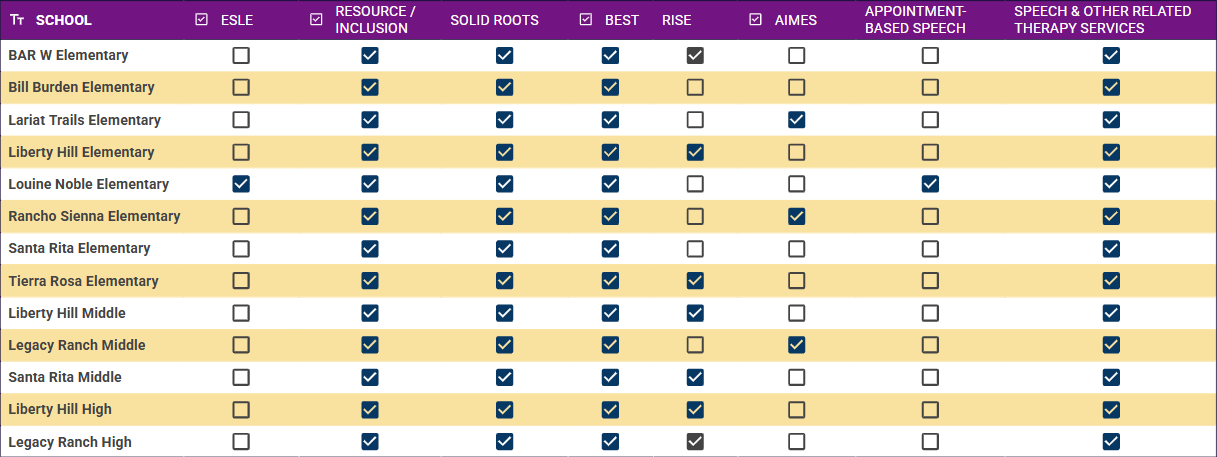
Texas Education Agency Parent & Family ResourcesWhich LHISD Campuses Offer Each Program?
Program locations are clustered across the district to support continuity, appropriate staffing and student access.
Program FAQs
Answers to common questions about services, transportation, program locations and sibling placement.
What if my student’s program is not offered at our zoned campus?
Decisions regarding services needed to meet a student’s needs are determined by the members of the ARD/IEP committee and are based on information presented at the ARD/IEP meeting. The committee will review the student’s needs and discuss recommended supports offered in a variety of settings.
If the ARD/IEP committee recommends a program that is not offered at the student’s home campus, the student will be assigned to a campus that does offer that program.
Will transportation be provided?
The student’s ARD/IEP meeting will discuss transportation and determine services that best meet the student’s needs. If the committee recommends services off the student’s home campus, special education transportation will be considered.
Special education transportation is provided only to students who have an identified need in their IEP. Any needed support, such as a monitor or safety device, will be addressed by the ARD/IEP committee and provided by the Transportation Department. A parent or guardian does not have to accept transportation.
What are the benefits of having programs clustered?
Clustering programs can provide access to the general education curriculum and peers, allow students to remain at one school for more of their academic career instead of transferring repeatedly, and support appropriate staffing even during vacancies or absences.
For example, ESLE classrooms are located with Pre-K classrooms to support access to same-age peers and the general education curriculum. Cluster sites are intended as a long-term solution as the district continues to grow and the number of students needing special education services increases.
Will my student have to move during the school year if the zoned campus does not offer the recommended program?
The ARD/IEP committee determines whether a student’s services can best be provided in a program not located at the student’s home campus. This can occur during the school year.
The committee also determines when services begin. That may be at a natural break, such as winter or spring break, or as soon as possible depending on the student’s needs.
I have multiple students enrolled in LHISD. Will they be able to attend the same campus?
The district’s goal is to keep siblings together as much as possible. Requests for sibling student transfers based on a special education program placement will be considered.
Transition and employment planning
Learn more about preparing for life after high school.
LHISD Transition Planning · SPEDTex Transition ResourcesQuestions About Special Education Programs?
Liberty Hill ISD Student Support Services can help families with information about programs, services and the ARD/IEP process.